ANY and SOME - Lesser Known T-SQL Keywords
Published: Oct 21, 2026
This was something else that came up in training and I can’t, for the life of me, remember how and why, but we seemed to end up on the topic and this came out. I thought I’d write a little blog about them just because I was amused (doesn’t take much) by how few people knew these even existed in the T-SQL language.
So what are they? Well, they’re basically the same as EXISTS, just a different syntax:
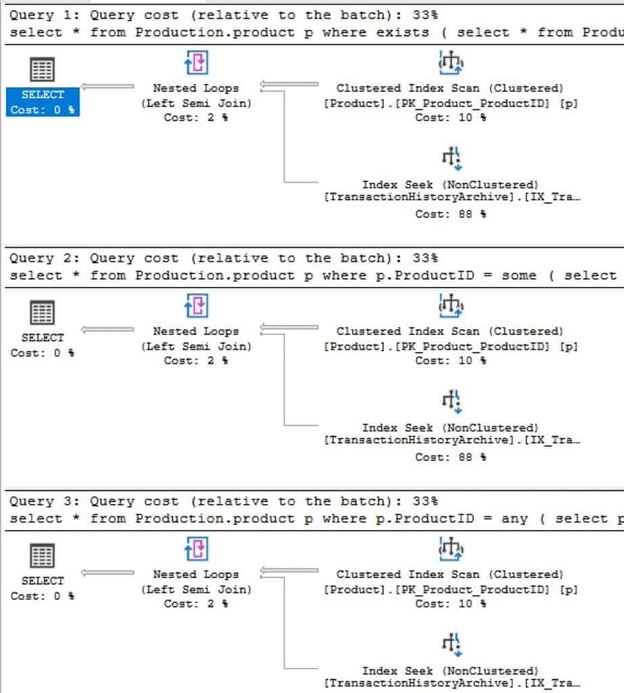
As you can see… they’re all identical execution plans. This is because internally the SQL Optimizer interprets them all as a “SOME” operator. I’ll prove that in my next blog post but, for the moment, you’ll just have to trust me on that one.
As mentioned, the only differences in these keywords are the syntax usage when you write the code. You can work them all out for yourself, but I’ll start you off with the following:
The above are identical and therefore, personally, I think that the SOME / ANY syntax is actually cleaner for a simple example… although if you want to add more complex join criteria then you’ll likely be best off writing it as an EXISTS.
So what are they? Well, they’re basically the same as EXISTS, just a different syntax:
select *
from Production.product p
where exists
(
       select *
       from Production.TransactionHistoryArchive t
       where p.ProductID = t.ProductID
)
select *
from Production.product p
where p.ProductID = some
(
       select productID
       from Production.TransactionHistoryArchive t
)

select *
from Production.product p
where p.ProductID = any
(
       select productID
       from Production.TransactionHistoryArchive t
)
As you can see… they’re all identical execution plans. This is because internally the SQL Optimizer interprets them all as a “SOME” operator. I’ll prove that in my next blog post but, for the moment, you’ll just have to trust me on that one.
As mentioned, the only differences in these keywords are the syntax usage when you write the code. You can work them all out for yourself, but I’ll start you off with the following:
select *
from Production.product p
where exists
(
       select *
       from Production.TransactionHistoryArchive t
       where p.ProductID <= t.ProductID
)

select *
from Production.product p
where p.ProductID <= some
(
       select productID
       from Production.TransactionHistoryArchive t
)
The above are identical and therefore, personally, I think that the SOME / ANY syntax is actually cleaner for a simple example… although if you want to add more complex join criteria then you’ll likely be best off writing it as an EXISTS.